
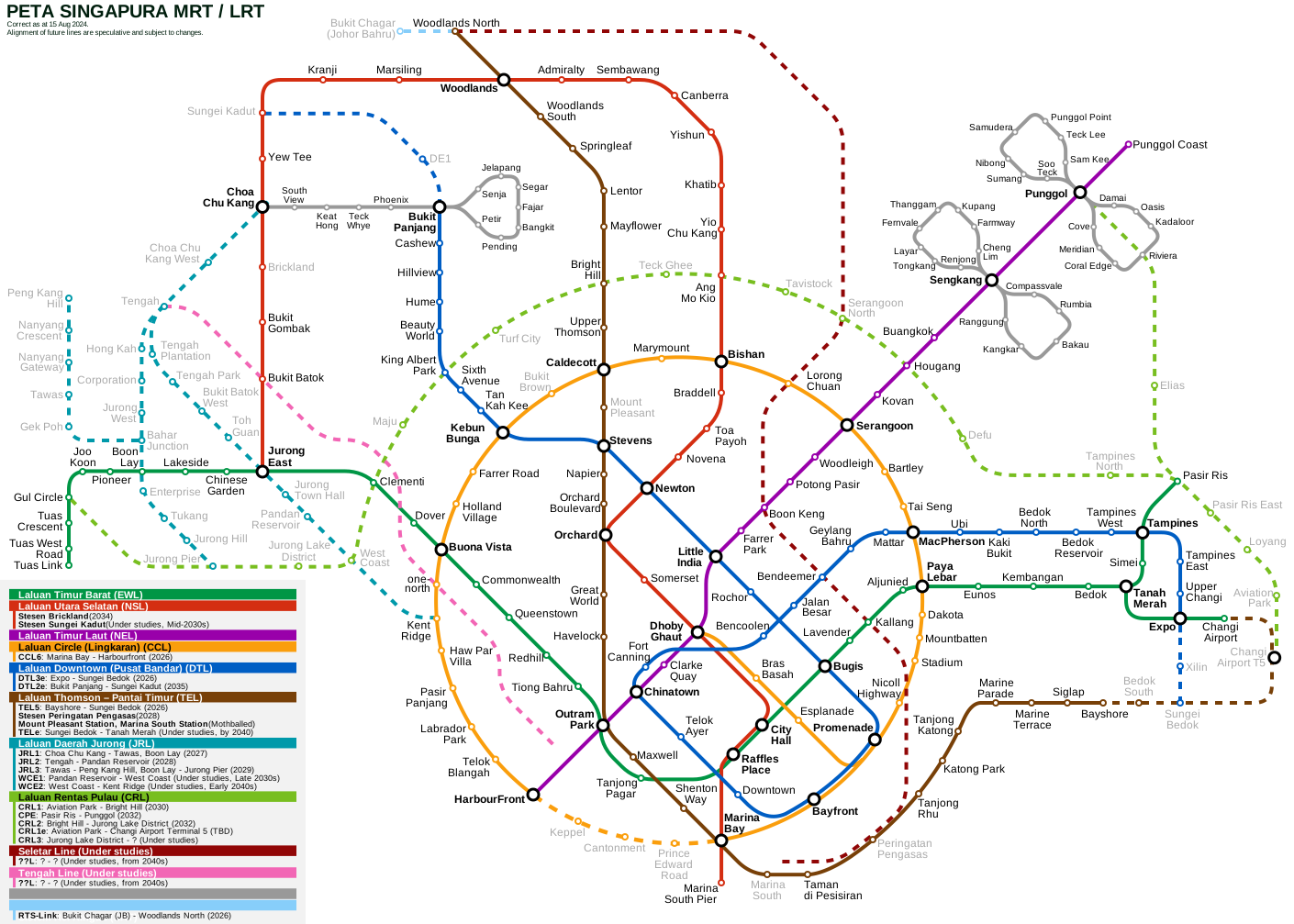
What is an MRT Map?
An MRT map, or Mass Rapid Transit map, is a visual guide to a city’s train network, designed to simplify navigation for commuters. It offers an overview of the rail system, showing routes, stations, and key interchanges in a clear and user-friendly format.
Singapore MRT maps typically use distinct colors or line styles to represent different train routes. Stations are marked with names, symbols, or codes to help passengers identify their boarding and alighting points easily. Interchange stations, where two or more train lines intersect, are highlighted to facilitate smooth transfers between lines.
These maps are essential tools for commuters, tourists, and anyone using public transportation, as they make route planning and navigation more accessible, even in complex urban transit systems.
Download The Updated MRT Map PDF in All Languages [2025 latest Version With New Stations]
Stay updated with the latest MRT map from the official Singapore Land Transport Authority (LTA), which includes all stations, operational lines, and an explanation for each legend and symbol on the map. This easy-to-read map is perfect for planning your route and understanding the MRT network at a glance.
Singapore MRT (Mass Rapid Transit) Lines Overview
Singapore’s MRT system consists of several lines, each identifiable by its unique colour:
- North-South Line (Red): Running from Jurong East in the west to Marina South Pier in the south, passing through key areas like Orchard and Raffles Place.
- East-West Line (Green): Running from Pasir Ris in the east to Tuas Link in the west, this line covers major hubs like Changi Airport and City Hall.
- North-East Line (Purple): Running from Punggol to HarbourFront, this line serves cultural hotspots like Little India and Chinatown.
- Circle Line (Yellow): A loop line linking HarbourFront to Marina Bay, passing through key areas like Paya Lebar and Bras Basah.
- Downtown Line (Blue): Running from Bukit Panjang in the northwest to Expo in the east, this line offers access to the downtown core and educational institutions.
- Thomson-East Coast Line (Brown): The newest addition, running from Woodlands North to Sungei Bedok, enhances connectivity in the northern and eastern regions.
Recommended article: Singapore’s 28 districts mapped across Core Central Region (CCR), Rest of Central Region (RCR), and Outside Central Region (OCR)
Looking for a property close to an MRT station of your choice? Check out your options here!
Key Transfer Stations in Singapore’s MRT Network
Interchanges are crucial for a seamless and comfortable travel experience across different lines. Below are key interchanges in MRT Singapore:
- Dhoby Ghaut: Connecting the North-South, North-East, and Circle Lines.
- Outram Park: Linking the East-West and North-East Lines.
- Marina Bay: A nexus for the North-South, Circle, and Thomson-East Coast Lines.
- City Hall: Where the North-South and East-West Lines meet.
- Bayfront: Connecting the Circle and Downtown Lines.
Interesting Facts to Know about Singapore MRT
1. Singapore’s MRT system is the first and oldest metro network in Southeast Asia, officially launched in 1987 with the opening of the North-South Line between Yio Chu Kang and Toa Payoh.
2. The MRT system is well-reputed for its efficiency and punctuality, boasting an average train frequency of 2-3 minutes during peak hours and achieving some of the highest reliability standards globally.
3. The MRT network spans over 240 kilometers and has up to 142 stations (as of 2024). It connects almost every part of the city-state, making it a vital mode of transportation for millions daily.
How is the MRT line map in Singapore?
Currently, the island boasts an extensive rail network with over 142 stations spanning six MRT lines and covering a distance of 240km. This railway system caters to a daily ridership of over three million people. Additionally, there are two LRT lines comprising more than 40 stations, stretching over 28 km and serving a daily ridership of over 200 thousand individuals. To further expand the reach of the rail system, ongoing efforts are underway to construct additional networks.
In conjunction with the rail system, the Bukit Panjang, Sengkang, and Punggol areas are served by two Light Rapid Transit (LRT) systems. These LRT lines act as feeder services, conveniently connecting commuters to their respective residences.
The responsibility for operating the train system rests with two public transport operators. SMRT Corporation Ltd (SMRT) oversees the North-South Line, East-West Line, Circle Line, Thomson-East Coast Line, and the Bukit Panjang LRT. Meanwhile, SBS Transit (SBST) manages the North East Line, Downtown Line, and Sengkang-Punggol LRT.
What are the operating hours for the trains on the MRT map in Singapore?
- Operating Hours: Typically, MRT services operate from about 5:30 AM to around midnight. Extended hours are available during public holidays and special events.
- Train Frequency: Trains arrive every 2-5 minutes during peak hours and 5-7 minutes during off-peak hours.
The train service runs daily from around 5:30 am until midnight, with extended hours possible during festive periods. To keep track of any changes in the operating hours, you can check the SMRT and SBS Transit websites or download the MyTransport app, available for both iOS and Android devices.
During the peak hours of 7 am to 9 am, the trains run at a quicker frequency of approximately every 2 to 3 minutes, ensuring a reliable and readily available service for commuters. During off-peak times, such as outside the busiest hours, the frequency slightly decreases to around 5 to 7 minutes between trains, which still offers passengers reasonable intervals for their journeys.
Recommended article: 5 Condos Under $1k psf Near MRT stations, AND Reputable Schools
Singapore MRT Ticketing and Payment System
Singapore’s MRT system provides multiple ticketing options to fulfill the needs of different types of commuters, whether you’re a frequent traveler or a tourist exploring the city. The ticket options include:
1. Standard Ticket: Designed for single or return trips, the Standard Ticket is best for occasional riders or tourists who may not require a reusable card.
Where to buy: These tickets can be purchased from ticketing machines at any MRT station. Simply select your destination, pay the fare, and the machine will dispense your ticket.
Usage: The ticket is valid for one journey (or two if it’s a return ticket) and must be tapped on the card reader at the entry and exit gates.
2. EZ-Link Card: A reusable smart card ideal for regular commuters. It offers lower fares compared to Standard Tickets and allows for seamless transfers between buses and trains.
Where to buy: EZ-Link cards can be purchased and topped up at:
a) MRT station ticket offices
b) Passenger Service Centres
c) Convenience stores like 7-Eleven or Cheers for a small convenience fee
d) EZ-Link kiosks located at various public locations
e) SimplyGo app or ticket kiosks. You can download the app and use it for top-ups, or find your nearest SimplyGo kiosk and ask for a top-up
Usage: Tap the card on the reader at the entry and exit gates. The fare is automatically deducted based on the distance traveled.
3. Singapore Tourist Pass: A special pass for tourists that offers unlimited rides on MRT and buses for a fixed period (1, 2, or 3 days).
Where to get: Available at TransitLink Ticket Offices located at major MRT stations, including Changi Airport, Orchard stations, and City Hall.
Benefits: Ideal option for visitors looking to explore the city without worrying about topping up fares.
4. Contactless payment options: Commuters can use credit or debit cards with contactless payment features (e.g., Visa PayWave, Mastercard PayPass) or mobile payment platforms like Apple Pay, Google Pay, and Samsung Pay for quick and easy access.
How to use: Tap your card or device on the card reader at the gates. Fares are charged directly to your bank account.
Essential Tips for Using MRT:
– Always check the balance on your EZ-Link card or ensure sufficient funds on your contactless payment card before boarding.
– For Standard Tickets, keep the ticket intact until the end of your journey, as you’ll need it to exit the system.
– Consider the Singapore Tourist Pass if you plan to use public transport extensively during your visit.
The Cross Island Line (CRL) – Progresses, stages, and newest updates
- Phase 1 (CRL1):
- Started construction in 2020.
- It spans 29 kilometres and has 12 stations from Aviation Park to Bright Hill.
- Expected completion in 2030.
- Punggol Extension (CRLe):
- Construction began in 2022.
- Covers a 7.3-kilometre extension with four stations from Pasir Ris to Punggol.
- Completion delayed to 2032 due to COVID-19.
- Phase 2 (CRL2):
- Construction started in 2023.
- It spans 15 kilometres with six stations from Turf City to Jurong Lake District.
- Set to open in 2032.
The future plans:
Concepts for the Paya Lebar Air Base redevelopment include adding a station between Defu and Tampines North stations.
Updates on planned new stations:
The Land Transport Authority (LTA) announced on Monday, January 6th, that the Downtown Line (DTL) will be extended by three new stations by 2035, improving connectivity in the northwest region of Singapore (Source).
This extension will see the DTL connect to the North-South Line (NSL), significantly improving travel options for residents in the area.
The first new station will be located along Sungei Kadut Avenue. The second station will serve as the new terminus for the DTL, acting as an underground interchange station. This interchange station will connect to a third, aboveground station on the NSL, located between the existing Yew Tee and Kranji stations.
Note: This information is based on the LTA’s announcement and may be subject to future updates.
Thomson-East Coast Line (TEL) updates
Seven new stations on the Thomson-East Coast Line (TEL) Stage 4 will open for passenger service on June 23, 2024. The new stations include:
- TE23 Tanjong Rhu
- TE24 Katong Park
- TE25 Tanjong Katong
- TE26 Marine Parade
- TE27 Marine Terrace
- TE28 Siglap
- TE29 Bayshore
These stations will significantly improve accessibility for residents in the East Coast region, reducing travel times by more than 50% for some commutes. For instance, a trip from Marine Parade to Shenton Way will take only 20 minutes on the TEL compared to 40 minutes by bus and train.
Future developments to TEL
- 2026: TEL Stage 5, which includes Bedok South, Sungei Bedok interchange, and Xilin stations, along with the new East Coast Integrated Depot, is set to open. This depot will support three MRT lines: TEL, Downtown Line (DTL), and East-West Line (EWL).
- Founders’ Memorial Station: This station will open in tandem with the Founders’ Memorial in 2025.
About Singapore Land Transport Authority (LTA)
The Singapore Land Transport Authority (LTA) plays a crucial role in shaping the city’s transport landscape. Established in 1995, LTA is responsible for planning and managing the country’s land transport system, including the extensive MRT network and public bus services. Its responsibilities extend beyond just infrastructure; LTA also regulates vehicle ownership, enforces traffic management, and promotes sustainable transport initiatives. By integrating technology and innovation, LTA works to create a reliable, seamless, and environmentally friendly transport system that meets the needs of Singapore’s residents and supports the nation’s development as a dynamic global city.
Explore our listings tailored to your preferred MRT station here.
FAQs about Singapore MRT
1. What are the operating hours of the MRT?
The MRT generally operates daily from 5:30 AM to around midnight, with variations depending on the line and station. During public holidays or special events, operating hours may be extended.
2. How frequently do MRT trains run?
Trains run every 2 to 5 minutes during peak hours and 5 to 7 minutes during off-peak hours. However, train intervals may vary based on the line and time of day.
3. How can I plan my MRT journey?
You can use apps like MyTransport.SG or Google Maps to plan your route. MRT maps are also available at stations and online to help you navigate.
4. What happens if I fail to tap in or out with my EZ-Link card?
Failing to tap in or out results in the maximum fare being deducted. If this happens, you can request a fare adjustment at the Passenger Service Centre.
5. Are there child concessions for MRT rides?
Yes, for children under 7 years old and below 0.9m in height, ride for free. Concession cards are available for students and other eligible groups for discounted fares.
6. What safety measures are in place on the MRT?
All MRT stations are equipped with CCTV surveillance, platform screen doors for safety, and emergency help points. Passengers are advised to comply with safety guidelines and report suspicious activities to staff.